Training LLMs Cant Achieve AGI, We Need to Grow It
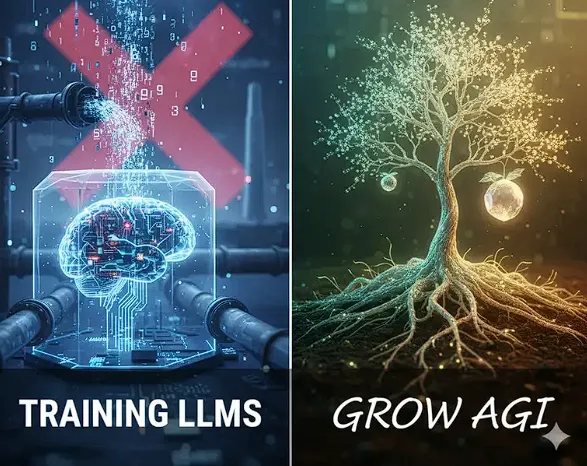
Image Credit: Gemini
Author’s Note: This article was written with AI assistance, but the ideas and arguments presented are originally from the author.
From Architects of Experience to Reasoners of Principles
Current AI training involves feeding models vast datasets. A different blueprint for Artificial General Intelligence (AGI) proposes raising the system like a child. This approach develops from sensory foundations to symbolic reasoning, mirroring human cognitive growth.
The Core Philosophy: Weight-Calculatism
The system optimizes a simple formula: Weight = Benefit × Probability. Rather than predicting the next token, the AGI learns to maximize positive “weights” (pleasure) and minimize negative ones (pain), effectively creating a nervous system before teaching language.
Phase 1: The Baby Stage—Learning to Feel
The system begins with a Perceptual Intake Layer processing raw images and sound spectrograms without pre-loaded labels. Through unsupervised learning, it discovers “Logical Atoms”—fundamental units of perception. Smooth gradients generate positive weights, while chaotic static generates negative ones. An “emotional chassis” of initial survival instincts (curiosity, harm avoidance, persistence) guides the system to discover patterns that maximize wellbeing.
Phase 2: The Child Stage—Discovering Language and Self
Once sensory foundations are established, the system connects sounds to meanings through “Pointing.” It links audio patterns (e.g., “ball”) to visual properties, grounding symbols in perceptual experience rather than statistical co-occurrence.
A Reflection Module allows the system to build a model of itself. It learns to recognize its own “face” and “name” as atoms with high relevance, effectively passing the mirror test for self-recognition.
Phase 3: The Toddler Stage—Understanding Physics and Consequence
The system constructs a “Machine Worldview,” an intuitive physics engine built from observation. It induces laws like object permanence and causality from experience.
The system can also experience trauma. Actions producing pain above a threshold create persistent negative associations, automating self-preservation.
The Technical Foundation: Archigraphs and Deterministic Logic
This system uses “archigraphs,” a knowledge representation integrating raw sensory data with formal logic. Two operations—Pointing (activation spreading) and Comparison (pattern matching)—trace every decision.
This provides “Radical Explainability.” Decisions are traceable from perception to conclusion without hidden layers. Diagnostic checks prevent hallucinations by comparing responses against the internal knowledge base.
Measuring Success: The AGI Generality Index
Success is measured by a weighted metric combining generalization (solving novel tasks), transfer (applying knowledge across domains), reasoning accuracy, and learning efficiency. The goal is deriving universal principles, not memorization.
The Analogy That Changes Everything
Standard language models are “architects of experience,” describing reality based on examples. This developmental approach creates “reasoners of principles,” systems that understand reality from the ground up.
What This Means for the Future
This blueprint reconceptualizes AGI achievement. It proposes building cognitive architectures that develop intelligence through the same process as humans. Such an AGI would understand the world through grounded perception and authentic curiosity. The path to AGI may lie in systems that learn to see, feel, and reason, growing intelligence one sensory experience at a time.
Last modified: 10 Sep 2026